Networking Fridays
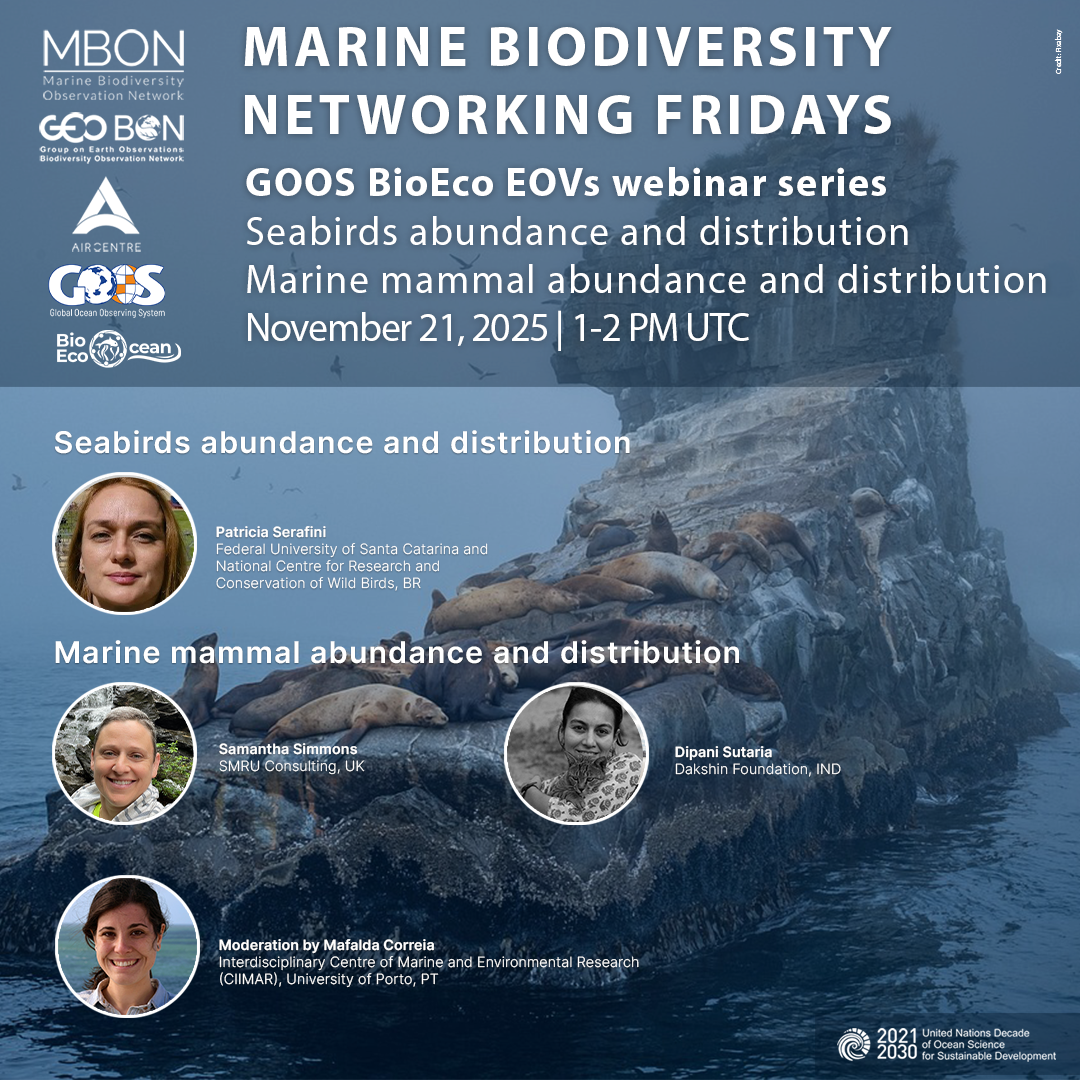
Marine Biodiversity Networking Friday || GOOS BioEco EOVs webinar | Seabirds abundance and distribution & Marine mammal abundance and distribution
Date
November 21, 2025, 1:00 PM - 2:00 PM UTC
AIR Centre Networking Fridays
More information about the Webinar series hereWatch the Recording
Watch on YouTube ↗On November 21st, 2025, from 1:00 to 2:00 PM UTC+0, join our webinar to discover how monitoring seabirds and marine mammals helps track ocean health, why these Essential Ocean Variables (EOVs) matter for our communities and decision-makers, and how you can make a difference.
In this session, you'll hear about:
- Why seabird and marine mammal data are vital for healthy oceans and smart decision making.
- The current status of ocean monitoring and gaps needing attention.
- How to amplify your impact via the GOOS international standards for ocean observations
- Meaningful ways you can contribute to ocean monitoring.
Whether you're a scientist, citizen observer, or simply passionate about the sea, this is your chance to get involved, ask questions, and be part of a global movement for ocean health. Register today and help improve our understanding of the world’s oceans - every data point counts!This webinar series is co-organized by the Marine Biodiversity Observation Network (MBON), the Atlantic International Research Centre (AIR Centre), the Global Ocean Observing System (GOOS) and the BioEcoOcean EU-funded project (Grant Agreement No. 101136748).Additional information:
- 2025 GOOS Status Report: https://www.ocean-ops.org/goosreport/
- Learn more about GOOS EOVs: https://www.goosocean.org/eov
- Miloslavich, P., et al. (2018). Essential Ocean Variables for sustained observations of marine biodiversity and ecosystems.
DOI: 10.1111/gcb.14108 - Ocean Best Practices System: https://www.oceanbestpractices.org/
- GOOS BioEco Portal: https://bioeco.goosocean.org/
- EOV metadata submission & data tool: https://eovmetadata.obis.org/
- Learn more about OBIS: https://obis.org/
- Update on New Zealand large-scale monitoring and tracking programme:
https://www.researchgate.net/profile/Johannes-Fischer/publication/392696489_An_update_on_the_New_Zealand_largescale_monitoring_and_tracking_programme_with_improved_insights_into_trends_and_distribution/links/684dee217869fe75c559407a/An-update-on-the-New-Zealand-largescale-monitoring-and-tracking-programme-with-improved-insights-into-trends-and-distribution.pdf - Interdecadal shifts in seabird distributions in the Northeast Pacific: https://doi.org/10.3354/meps15024
- ACAP – Avian flu: https://acap.aq/resources/disease-threats/avian-flu
- ACAP census guidelines for albatrosses and petrels: https://www.acap.aq/resources/acap-conservation-guidelines/2187-censusguidelines/
- Seabird Tracking Database: https://www.seabirdtracking.org/
- Observing approaches – marine mammals: https://www.marinemammals.in
Speakers
Seabirds abundance and distribution
Patricia Serafini
Federal University of Santa Catarina and National Centre for Research and Conservation of Wild Birds, BR
Patricia Pereira Serafini is a veterinarian with a Master’s degree in Biological Sciences from the State University of Londrina (UEL) and currently a PhD candidate at the Federal University of Santa Catarina (UFSC) in collaboration with the University of Oxford and the British Antarctic Survey (BAS). She has worked since 2010 on the conservation of albatrosses, petrels, and other seabirds, and serves as an environmental analyst at the National Centre for Research and Conservation of Wild Birds (CEMAVE/ICMBio/Brazilian Ministry of the Environment). Since 2019, Patricia has been a co-convenor of the Population and Conservation Status Working Group of the Agreement for the Conservation of Albatrosses and Petrels (ACAP/UN). Her work applies a One Health perspective to investigate the seabird conservation crisis, with a focus on population monitoring, molecular biology, ecotoxicology, and epidemiology.
Marine mammal abundance and distribution
Samantha SimmonsSMRU Consulting, UK
Samantha Simmons is a marine mammal biologist with a focus on seals and sea lions. Originally from the UK, she studied Marine and Environmental Biology at the University of St. Andrews, before moving to California for her Master’s and PhD at UC Santa Cruz. Her work focuses on how marine mammals interact with their environment and how they’re affected by both natural and human-made stressors (individually and cumulatively). After spending 13 years with the US Marine Mammal Commission (www.mmc.gov) advising on science-based policy, Samantha returned to the UK in 2022 as a Principal Scientist at SMRU Consulting (www.smruconsulting.com). She’s also been a panel co-chair for GOOS BioEco and now represents the marine mammal EOV on the panel.
Dipani Sutaria
Dakshin Foundation, IND
Dipani is an environmentalist and an ecologist with a MSc in Marine Biology from University of Massachusetts and a PhD in Earth and Environmental Sciences from James Cook University, Australia. Dipani has been studying marine megafauna including turtles, elasmobranchs and marine mammals in India since 1998 and has mentored the next generation of researchers and naturalists since 2009. Dipani is an Adjunct Senior Research Fellow at JCU, Australia; Research Affiliate at Dakshin Foundation, India; and a member of the IUCN Cetacean Specialist Group, Marine Mammal Protected Areas Taskforce and is Chairing the Conservation Committee at the Society of Marine Mammalogy. In India, she is part of the marine mammal research and conservation network of India (www.marinemammals.in) and has played a key role in the designation of Important Marine Mammal Areas in the Arabian sea and the Bay of Bengal.
Moderator
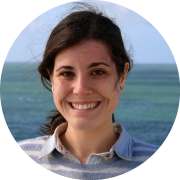
Mafalda Correia
Interdisciplinary Centre of Marine and Environmental Research (CIIMAR), University of Porto, PT
Ana Mafalda Correia is a postdoctoral researcher at the Interdisciplinary Centre of Marine and Environmental Research (CIIMAR, University of Porto) with a PhD in Biology from the Faculty of Sciences of the University of Porto. Since 2011, her research in the field of marine ecology bridges fundamental research and applied conservation. Her expertise spans marine megafauna ecology, spatial modelling, and marine conservation. She is involved in international initiatives on large-scale monitoring of marine mammals in the Eastern North Atlantic and recently contributed as an expert for the identification of Important Marine Mammal Areas (IMMAs) in the Northeast Atlantic.
Programme · UTC
Speakers
Marine mammal abundance and distribution
Patricia Pereira Serafini is a veterinarian with a Master’s degree in Biological Sciences from the State University of Londrina (UEL) and currently a PhD candidate at the Federal University of Santa Catarina (UFSC) in collaboration with the University of Oxford and the British Antarctic Survey (BAS). She has worked since 2010 on the conservation of albatrosses, petrels, and other seabirds, and serves as an environmental analyst at the National Centre for Research and Conservation of Wild Birds (CEMAVE/ICMBio/Brazilian Ministry of the Environment). Since 2019, Patricia has been a co-convenor of the Population and Conservation Status Working Group of the Agreement for the Conservation of Albatrosses and Petrels (ACAP/UN). Her work applies a One Health perspective to investigate the seabird conservation crisis, with a focus on population monitoring, molecular biology, ecotoxicology, and epidemiology.
Samantha Simmons
SMRU Consulting, UK
Samantha Simmons is a marine mammal biologist with a focus on seals and sea lions. Originally from the UK, she studied Marine and Environmental Biology at the University of St. Andrews, before moving to California for her Master’s and PhD at UC Santa Cruz. Her work focuses on how marine mammals interact with their environment and how they’re affected by both natural and human-made stressors (individually and cumulatively). After spending 13 years with the US Marine Mammal Commission ( ) advising on science-based policy, Samantha returned to the UK in 2022 as a Principal Scientist at SMRU Consulting ( ). She’s also been a panel co-chair for GOOS BioEco and now represents the marine mammal EOV on the panel.
Dipani Sutaria
Dipani is an environmentalist and an ecologist with a MSc in Marine Biology from University of Massachusetts and a PhD in Earth and Environmental Sciences from James Cook University, Australia. Dipani has been studying marine megafauna including turtles, elasmobranchs and marine mammals in India since 1998 and has mentored the next generation of researchers and naturalists since 2009. Dipani is an Adjunct Senior Research Fellow at JCU, Australia; Research Affiliate at Dakshin Foundation, India; and a member of the IUCN Cetacean Specialist Group, Marine Mammal Protected Areas Taskforce and is Chairing the Conservation Committee at the Society of Marine Mammalogy. In India, she is part of the marine mammal research and conservation network of India ( ) and has played a key role in the designation of Important Marine Mammal Areas in the Arabian sea and the Bay of Bengal.
Mafalda Correia
Ana Mafalda Correia is a postdoctoral researcher at the Interdisciplinary Centre of Marine and Environmental Research (CIIMAR, University of Porto) with a PhD in Biology from the Faculty of Sciences of the University of Porto. Since 2011, her research in the field of marine ecology bridges fundamental research and applied conservation. Her expertise spans marine megafauna ecology, spatial modelling, and marine conservation. She is involved in international initiatives on large-scale monitoring of marine mammals in the Eastern North Atlantic and recently contributed as an expert for the identification of Important Marine Mammal Areas (IMMAs) in the Northeast Atlantic.